"... there is much drudgery and very little excitement about the farm servant's duties, and I believe the young men dislike the former and long for the latter. By the labourers themselves slight importance is attached to the healthy character of country life in comparison with various branches of town labour. That phase of the question sinks into insignificance in their estimation, and only the shorter hours, numerous holidays and ever present busy bustle and excitement of town life or the neat uniform and genteel work of the police constable or railway porter, are present to the mind of our young farm servant."
Royal Commission on Labour, 1893. (Quoted in Tom Devine's The Scottish Nation 1700-2007, pp 466-467.)
To have quotes and extracts similar to the above with me when I visit an abandoned farm cottage help to create stories in my mind about the last occupants. Maybe there was no sadness about leaving. Maybe there was excitement and relief. Maybe they skipped down those stairs on their last day there.
Researching the history of a place and the possible reasons for abandoning it can change the mood of the image I'm seeking. The light coming through the downstairs door and the windows in the above image - do they bring light into a sad, abandoned home or do they suggest some brighter future beyond the hard, isolated life of the farm labourer?
At the time I felt the last occupants were anxious and nervous about moving away.
Having read the above quote, does it change the mood you may have felt looking at the image?
Thursday, 6 March 2014


Wednesday, 5 March 2014
12 layers of the past. Finding 'me' under there.

12 layers of the past., a photo by James_at_Slack on Flickr.
I stood at this colourful view into the 'past' layers of wallpaper for a while. It was like peeling back the stories of the place - why would you put layer upon layer of wallpaper on the wall? what can it tell us about the people who lived here? who might have lived here? what would it have been like to live here?
Later, back home processing the image, I started daydreaming about being able to strip away layers of my own history to see the changes, to see the good choices, to see the not so good choices with the benefit of hindsight. What would the 'original wall' look like, stripped of all the coverings? Would it be the real me or is the real me the accumulation of all these changes, all these choices, all these shifts of direction?
Last Easter holidays I began reading Steve Simon's book The Passionate Photographer, determined to really 'do it', i.e. work through his tasks and exercises, as the book had been highly recommended to me.
Well, did I not get stuck at Step One - finding your inspiration, finding your passion!
A huge part of getting that right is knowing who you are and it seems each time I try to find 'me' it becomes a bit more elusive than I expected. Am I alone is this? Is it just me or is trying to know 'who you are' really quite difficult?
Maybe I'm a bit more Anaglypta than Flock - repeated patterns?
Tuesday, 4 March 2014
Past, present and what future? Balhennie, Groddie.
There are times when so much seems to be happening beyond your control that you just decide to take each day as it comes.
Today was one of those days.
In an attempt to do something 'under my control', I decided late in the afternoon, to grab the old D50 with a plastic Holga lens on it and go to a ruin called Balhennie, not far from my house.
When I got there, the sun had just dipped behind Morven casting a shadow on the abandoned farmhouse of Balhennie. Missed my shot. Undaunted, I headed for inside the cottage with camera gear that would struggle to capture anything in the darkness.
A walker then appeared, just down from Morven. He was from Crieff but was staying in Craigendarroch. He also intended to take a picture of Balhennie in the evening sunlight. We both made comment on how quickly the sun dipped away.
He was still going to take a picture anyway and would I go inside and stand by the window? Why not, I thought. Might as well keep flowing with the flow. Two snaps later, and he was gone.
My efforts at getting anything decent inside wasn't happening. The light was too low and I had no tripod.

I went back to stand at the window and took the image above. I stared at the path leading to the open gate but you'd have to make sure you avoided the puddles. The sunshine and hills are beyond but a fence blocks the way so just follow the path and hope it leads to an opening? That's when I realised I was standing in someone's past in the present wondering about the future.
It was also then that I realised I'd never used the on camera flash with the Holga lens. Back to taking pictures and back in control, having fun and not thinking about anything.
Here's two images using the flash:


And some more window images for good measure.


Monday, 3 March 2014
The bike at Blairglass

I have been visiting this abandoned farmhouse, Blairglass in the Gairn Shiel area for nearly 10 years now and it never ceases to amaze to me that this old bike is still there and, incredibly, still leaning upright against the wall, despite all that the Cairngorm winters throw at it.
I can't find any information about Blairglass farmhouse and farm, which surprises me as it was an extensive and substantial farm. The last occupants had some of their belongings dumped near the house.
Why?
Who lived here and why did they leave?
Who owned the bike against the wall?
Blairglass farmhouse has a modern door on it and is locked, suggesting that maybe it is still used for shooting parties to have somewhere to go for a dram and food.
In the summer, someone puts up many beehives nearby. I wonder if there was always bees kept at Blairglass?
If only that bike could talk!
Sunday, 2 March 2014
Macdonald Aisle or tomb.

This is the private burial ground of the Macdonalds at Remicras. It is about half an acre in size, surrounded by a stone wall and one can see the remains of where an iron gate used to be. The Aisle is basically a square vault with two headstones. One states, ‘Within this tomb is laid the remains of Jas Macdonald Esq of Rineton who died on the 9th May 1776. Likewise of Helen Tulloch, his wife and several other Descendants.’ The inscription of a daughter of Helen and James, Christine, reads, ‘…wife of Lieut John Farquharson of 76th regiment…she departed this life on 29th August 1781, in the 49th year of her age, leaving one son and one daughter. The stone is erected by her son, Colonel Farquharson of the 25th Regiment.’ The stone was erected sometime between 1814 and 1817. A right in perpetuity was granted to the Macdonalds for their burial ground on payment of a nominal feu duty of one and a half pence (old money) per annum.
It was not an easy place to photograph. I liked the decayed, dead, fallen and abandoned look of this shot, as well as the only blink of sun I got on the Aisle. I decided to try the cheap plastic Holga lens on my D50 and I'm happier with this image than the ones with the other expensive lens.
Saturday, 1 March 2014
Remicras settlement and the Macdonalds

At the settlement of Remicras (or Riemicras as I’ve seen in an other book) you can see ruins of longhouses and later ruins of a farmhouse and U shaped steading. There is a kiln and a grain mill with the remains of the mill dam. The wee stone bridge across the stream in still in situ. The lade was well engineered and would have taken considerable effort to construct. The whole area seems to have benefited from a substantial investment to construct these buildings that replace the earlier buildings. This was the home to the Macdonald’s who claimed to be descended from the third son of John, Lord of the Isles. Legend has it that they got their property from the Earl of Mar after the battle of Harlaw (1411) when Macdonald was taken prisoner. The residents of this Macdonald ‘kingdom’ were tenants, many with the same surname. The land was sold to Invercauld in 1822 but there were still Macdonalds there until 1880 when most had left to make way for more profitable sheep. Most would have gone to cities to find work but many would have tried their luck abroad in America, Canada or New Zealand.
Wednesday, 11 December 2013
The Impassioned Eye
The title comes from a documentary on Henri Cartier-Bresson which I recently watched again. I'm looking back at photographers I admire to see what I can learn from them or what may inspire me to help me move forward with my photography.
Bresson's work is well known and he is often considered one the best photographer of all time. Watching the documentary again, it was interesting what lessons I actually took from it.
We all know that, 'decisive moment' phrase and his images are testament to the joy of geometry, when everything seems right and balanced. He had a questioning stare. He could sense there was an image there - it was just a matter of looking and waiting.
There doesn't seem to be any real, deep messages in most of his images. They are celebrations of beauty of form and emotions. He saw, he felt and captured that moment as everything 'clicked' into place.
He also often shot was amused him. That simple - he looked, saw aspects of life that amused him and he captured these at just the right moment.
His images aside, what I was inspired by as much as, if not more by, was the way he lived and embraced life. He was clearly deeply moved by classical music. Drawing and painting was a real passion and something he continued to do all his life. He read poetry and most of his friends were artists. He had a huge respect for maths and mathematicians. He lived one day at a time, grateful for all the joy and pleasure that day brought. His fantastic portraits captured his love for his friends and his respect for their talent and work.
The lesson I took from the Bresson documentary is to engage with life - all aspects of life; to be curious, always looking and questioning. Make more room for science, literature, poetry, music, theatre, art, friends and family - probably at the expense of photography - to improve my creativity and perhaps my photography.
I've talked about this idea before - that if you want to improve your photography, then embrace life more. But watching Bresson was like some kind of reassuring proof for me.

Bresson's work is well known and he is often considered one the best photographer of all time. Watching the documentary again, it was interesting what lessons I actually took from it.
We all know that, 'decisive moment' phrase and his images are testament to the joy of geometry, when everything seems right and balanced. He had a questioning stare. He could sense there was an image there - it was just a matter of looking and waiting.
There doesn't seem to be any real, deep messages in most of his images. They are celebrations of beauty of form and emotions. He saw, he felt and captured that moment as everything 'clicked' into place.
He also often shot was amused him. That simple - he looked, saw aspects of life that amused him and he captured these at just the right moment.
His images aside, what I was inspired by as much as, if not more by, was the way he lived and embraced life. He was clearly deeply moved by classical music. Drawing and painting was a real passion and something he continued to do all his life. He read poetry and most of his friends were artists. He had a huge respect for maths and mathematicians. He lived one day at a time, grateful for all the joy and pleasure that day brought. His fantastic portraits captured his love for his friends and his respect for their talent and work.
The lesson I took from the Bresson documentary is to engage with life - all aspects of life; to be curious, always looking and questioning. Make more room for science, literature, poetry, music, theatre, art, friends and family - probably at the expense of photography - to improve my creativity and perhaps my photography.
I've talked about this idea before - that if you want to improve your photography, then embrace life more. But watching Bresson was like some kind of reassuring proof for me.
Sunday, 24 November 2013
Finding time or wasting time?
This is a subject that interests me a lot.
I've heard full time photographers talk about how they put up with doing commercial work so they can have some money to take a few months off doing their own,creative work. Most aim for getting about three months to themselves to be creative. It was hearing this that made me realise that, although I work full time in a job that is still regarded as one of the most stressful, teaching, I have 12 weeks holidays a year, ie three months!
Why couldn't I get more creative work done?
Well, it takes time to clear your head of work concerns, time to sit and think. Also, there are major projects I like to get on with at home - stuff that needs weeks of time. So it gets back to priorities and taking into account other people and your responsibilities.
The bottom line for me is, and it is this point that I think that separates those who achieve their goals and those who don't, work ethic. It is getting up off your backside and doing it whenever, wherever, no matter how tired you feel. It's that 10,000 hours thing Malcolm Gladwell talks about. As Nike said, just do it. But that means everything - work, family duties, social duties and being creative.
Procrastination, tiredness, apathy, be gone with you!

I've heard full time photographers talk about how they put up with doing commercial work so they can have some money to take a few months off doing their own,creative work. Most aim for getting about three months to themselves to be creative. It was hearing this that made me realise that, although I work full time in a job that is still regarded as one of the most stressful, teaching, I have 12 weeks holidays a year, ie three months!
Why couldn't I get more creative work done?
Well, it takes time to clear your head of work concerns, time to sit and think. Also, there are major projects I like to get on with at home - stuff that needs weeks of time. So it gets back to priorities and taking into account other people and your responsibilities.
The bottom line for me is, and it is this point that I think that separates those who achieve their goals and those who don't, work ethic. It is getting up off your backside and doing it whenever, wherever, no matter how tired you feel. It's that 10,000 hours thing Malcolm Gladwell talks about. As Nike said, just do it. But that means everything - work, family duties, social duties and being creative.
Procrastination, tiredness, apathy, be gone with you!
Wednesday, 20 November 2013
The journey to the image.
Often, when I discover and explore an abandoned cottage or community, I get excited, engrossed, moved, scared even.
Before I even step inside a ruin, there is usually some reading days beforehand on the history of the area and /or the people who once lived there. Then there's the maps and route planning to be done, checking the weather and finding a free weekend to go.
The walk to the ruin can be the best and worst part of the day. Either way, it affects how I will make images that day.
Sometimes, but not often, I may have company. The conversations on the way may also alter my feelings and mood. I may be enjoying the company so much, the actual picture taking can get in the way!
The surrounding area of many of the ruins I go to is stunning in the right time of the year and weather. I can be so chilled and relaxed in my surroundings that, again, taking pictures can sometime seem like a 'business' part to the pleasure of the trip.
However, more often than not, it's when I get to the ruin and I'm inside taking it all in and finding the right feeling and mood within myself, that I finally make an image and I'm totally in a zone that compliments everything that has gone before. I get a sense of purpose. I try to give this abandoned place some oxygen to its dying embers. I try to almost transmit what I see in front of me to the previous occupants so they can once again be there.
When I return home from a successful exploration, I'm buzzing, I feel recharged and de-stressed. I was totally focused for a period of time and all worries and concerns disappeared for a moment.
When it comes to actually uploading the images, processing them and finally sharing them, I'm finding it more of a chore. Why? Well, to be honest, many images are just ignore or glanced at. I can totally understand this. Most people have no interest in seeing old, abandoned buildings. It bores them and when I upload image after image like the one above, they quickly pass by.
I am getting better at not getting disappointed and upset that my images are not hugely popular. Don't get me wrong, and don't think I'm looking for sympathy or faint praise (or whatever the phrase is), I appreciate the many people who have commented on my work, supported me, encouraged me and, to my surprise, bought my work and hung on their wall. No, what I'm beginning to think is, this slight disappoinment can, at times, put a wee cloud over an otherwise great experience.
So, what am I trying to say here? Well, I'm beginning to sense that the preparation and journey is as much about my creative process as making the image. Maybe one day I'll make a sketch, or record the sounds I hear or even try to write something to express how I feel, rather than, or as well as making images. I could even start drawing on the images.
I should remember that nothing can take away the memory of the day, the feelings I had and the fact that I combined my love of history, walking, Scotland and photography.
I'd love to hear if you have any thoughts on 'the journey to the image'.

Before I even step inside a ruin, there is usually some reading days beforehand on the history of the area and /or the people who once lived there. Then there's the maps and route planning to be done, checking the weather and finding a free weekend to go.
The walk to the ruin can be the best and worst part of the day. Either way, it affects how I will make images that day.
Sometimes, but not often, I may have company. The conversations on the way may also alter my feelings and mood. I may be enjoying the company so much, the actual picture taking can get in the way!
The surrounding area of many of the ruins I go to is stunning in the right time of the year and weather. I can be so chilled and relaxed in my surroundings that, again, taking pictures can sometime seem like a 'business' part to the pleasure of the trip.
However, more often than not, it's when I get to the ruin and I'm inside taking it all in and finding the right feeling and mood within myself, that I finally make an image and I'm totally in a zone that compliments everything that has gone before. I get a sense of purpose. I try to give this abandoned place some oxygen to its dying embers. I try to almost transmit what I see in front of me to the previous occupants so they can once again be there.
When I return home from a successful exploration, I'm buzzing, I feel recharged and de-stressed. I was totally focused for a period of time and all worries and concerns disappeared for a moment.
When it comes to actually uploading the images, processing them and finally sharing them, I'm finding it more of a chore. Why? Well, to be honest, many images are just ignore or glanced at. I can totally understand this. Most people have no interest in seeing old, abandoned buildings. It bores them and when I upload image after image like the one above, they quickly pass by.
I am getting better at not getting disappointed and upset that my images are not hugely popular. Don't get me wrong, and don't think I'm looking for sympathy or faint praise (or whatever the phrase is), I appreciate the many people who have commented on my work, supported me, encouraged me and, to my surprise, bought my work and hung on their wall. No, what I'm beginning to think is, this slight disappoinment can, at times, put a wee cloud over an otherwise great experience.
So, what am I trying to say here? Well, I'm beginning to sense that the preparation and journey is as much about my creative process as making the image. Maybe one day I'll make a sketch, or record the sounds I hear or even try to write something to express how I feel, rather than, or as well as making images. I could even start drawing on the images.
I should remember that nothing can take away the memory of the day, the feelings I had and the fact that I combined my love of history, walking, Scotland and photography.
I'd love to hear if you have any thoughts on 'the journey to the image'.
Monday, 18 November 2013
Looking out for the past in the present, Allalogie.
Had a great weekend this weekend.
It kind of started on Thursday night in Tarland at a talk and mini concert by a local accordian player called Rob McCombie. Great stories of his life and dance bands of north east Scotland followed as well as tunes to enhance the talk.
One of the best bits for me was finding out he was brought up in the house we own. So if you wanted to hear one of the best accordian players in the Howe of Cromar back then, you came to our house we now live in! What is interesting is, if you wanted to hear one of the best accordian players in the Buckie area, you came to our old family home to hear my late father play. He played in a dance band called Bill Geddes Band all along the coast and in land too.
On Sunday I met up with Janet, a lady I know from our local history group. She wanted to show me an abandoned house I hadn't been to before. It was a great wee place with some interesting rooms. In fact, I enjoyed the area the ruin was in so much, I went back alone in the afternoon to explore further. This is when I took this shot of me standing looking out the bedroom window.
The textures of the hole in the roof and the hole in the floor I thought were wonderful. I also liked the shadow cast by the jam jar. This was a 3s exposure so I placed myself at the window for one of the many 'ghost' shots I seem to be doing at the moment. It seems to fit the mood of these abandoned, forgotten and derelict places. Maybe it's cliched and unimaginative but I like doing them for now.
Later, I went for a walk in the area and who should I meet but the accordian player Rob! That was a nice surpise meeting and chat. He is keen to come to see his old home. We are looking forward to it and I'm hoping he will once again fill the house with music. What sounds were common in Allalogie I wonder?
Threads of history and traces of memories are there to be found. Remembering and celebrating past places, events and people I truly enjoy and will keep on exploring and capturing abandoned Aberdeenshire.

It kind of started on Thursday night in Tarland at a talk and mini concert by a local accordian player called Rob McCombie. Great stories of his life and dance bands of north east Scotland followed as well as tunes to enhance the talk.
One of the best bits for me was finding out he was brought up in the house we own. So if you wanted to hear one of the best accordian players in the Howe of Cromar back then, you came to our house we now live in! What is interesting is, if you wanted to hear one of the best accordian players in the Buckie area, you came to our old family home to hear my late father play. He played in a dance band called Bill Geddes Band all along the coast and in land too.
On Sunday I met up with Janet, a lady I know from our local history group. She wanted to show me an abandoned house I hadn't been to before. It was a great wee place with some interesting rooms. In fact, I enjoyed the area the ruin was in so much, I went back alone in the afternoon to explore further. This is when I took this shot of me standing looking out the bedroom window.
The textures of the hole in the roof and the hole in the floor I thought were wonderful. I also liked the shadow cast by the jam jar. This was a 3s exposure so I placed myself at the window for one of the many 'ghost' shots I seem to be doing at the moment. It seems to fit the mood of these abandoned, forgotten and derelict places. Maybe it's cliched and unimaginative but I like doing them for now.
Later, I went for a walk in the area and who should I meet but the accordian player Rob! That was a nice surpise meeting and chat. He is keen to come to see his old home. We are looking forward to it and I'm hoping he will once again fill the house with music. What sounds were common in Allalogie I wonder?
Threads of history and traces of memories are there to be found. Remembering and celebrating past places, events and people I truly enjoy and will keep on exploring and capturing abandoned Aberdeenshire.
Monday, 11 November 2013
It's not the building but the people.
This blog needs some attention. Slow restart starts today.
Since the last post way back in August, my main job, as a secondary school teacher of History, has consumed not only my time, but also my energy and thoughts. Clearly, this is not a healthy state of affairs but I'm not here to seek sympathy. There's nothing much I can do about it but get on with it as best I can. Thing is, it shouldn't be an excuse to stop doing the the things I enjoy.
On many occasions I thought I should really get a blog post up.
One of the things that put me off posting was the negative influence other blog post I had been looking at were having on me. They seemed so deep and meaningful, full of big words and obscure references to photographers, poets and artists I'd never heard of. Made me feel right stupid and ignorant. So I felt I had nothing of interest to say.
Of course, this is daft thinking.
This is my blog and I should be 'me' on here and nobody else.
However, the content should be interesting too! Trouble was, I tended to see what I was doing in my spare time as not very interesting. I was over thinking this whole blog thing I concluded.
Fact is, quite a few people are interested in my work, if the recent CD covers/booklets, messages and print sales are anything to go by. So, I have decided to just do more regular, short and pithy posts that may or may not interest you.
You see, when all is said and done, I look forward to Andrea's blog posts more than any of the other 'deep and meaningful' lengthy blogs. I must be a philistine with a short attention span who likes humour more than debates on 'art' that baffle me, bore me and go nowhere.
I recently tweeted a comment along the lines of: 'I'm just going to keep churning out my stuff and remind myself why I wanted to do this in the first place. To hell with the rest.' I was feeling that there was too much crap getting far too much attention on social media for my liking. Jealous maybe, jealous probably, but it was getting to me so much I just wanted to remove myself from the
backslapping, mutual appreciation environment and get back to me, desperately attempting to satisfy a creative itch.
Like the title of the image of the abandoned church above, my creative efforts are not about social media, they should be about me.

Since the last post way back in August, my main job, as a secondary school teacher of History, has consumed not only my time, but also my energy and thoughts. Clearly, this is not a healthy state of affairs but I'm not here to seek sympathy. There's nothing much I can do about it but get on with it as best I can. Thing is, it shouldn't be an excuse to stop doing the the things I enjoy.
On many occasions I thought I should really get a blog post up.
One of the things that put me off posting was the negative influence other blog post I had been looking at were having on me. They seemed so deep and meaningful, full of big words and obscure references to photographers, poets and artists I'd never heard of. Made me feel right stupid and ignorant. So I felt I had nothing of interest to say.
Of course, this is daft thinking.
This is my blog and I should be 'me' on here and nobody else.
However, the content should be interesting too! Trouble was, I tended to see what I was doing in my spare time as not very interesting. I was over thinking this whole blog thing I concluded.
Fact is, quite a few people are interested in my work, if the recent CD covers/booklets, messages and print sales are anything to go by. So, I have decided to just do more regular, short and pithy posts that may or may not interest you.
You see, when all is said and done, I look forward to Andrea's blog posts more than any of the other 'deep and meaningful' lengthy blogs. I must be a philistine with a short attention span who likes humour more than debates on 'art' that baffle me, bore me and go nowhere.
I recently tweeted a comment along the lines of: 'I'm just going to keep churning out my stuff and remind myself why I wanted to do this in the first place. To hell with the rest.' I was feeling that there was too much crap getting far too much attention on social media for my liking. Jealous maybe, jealous probably, but it was getting to me so much I just wanted to remove myself from the
backslapping, mutual appreciation environment and get back to me, desperately attempting to satisfy a creative itch.
Like the title of the image of the abandoned church above, my creative efforts are not about social media, they should be about me.
Tuesday, 20 August 2013
A longing for something that constantly eludes the searcher.
A passage from Leaving Alexandria by Richard Holloway that got me thinking and nodding in recognition of that feeling. I just thought I'd share it with you.
' How can you make yourself one with a landscape? You can tramp over it, become so familiar with its contours that you never need a map, but you can never possess it. It is always eluding your desire, just out of reach, beyond your possessing. I did not know the word at the time, or the idea behind it, but on the hills I was experiencing latency, the sense of something hidden behind what is seen. How can you find words for what is beyond sound, make visible what vanishes when seen? .... I was looking for something beyond myself, something out there that would take me out of in here - the life that was going on in my head. I was looking for transcendence, the beyond that is sometimes encountered in the midst of things, usually when we are not looking for it. This is the stab of awareness that causes us to turn on our heels to catch the shadow that is behind us. It is the sense of a presence, beyond knowing, that we reach out towards. And it can be experienced as loneliness. We are missing something, either because it is not there or because we have not yet found it. ' (p.41)
Sunday, 18 August 2013
Reading can help you find that elusive 'me'.
Every now and then, I read a book which helps me understand myself better. Some authors can eloquently put into words feelings and experiences I struggle to.
This summer I read Richard Holloway’s autobiography Leaving Alexandria. I had listened to him on Radio Scotland and he sounded like he had an interesting story to tell.
I really enjoyed his biography but it was his meditations on some of his past experiences that resonated with me. I found myself pausing my reading and thinking, ‘ that’s me he’s describing’ or ‘that’s exactly how I feel’.
Anyway, I wanted to collect some of these passages from the book in some blog posts, I suppose as a way of giving them further thought and to share with anyone who might read this.
Quite early on Richard found that 'he was theoretically qualified to do something he was actually incapable of performing. He had the air of confidence and of appearing to be knowledgeable about something he was actually making up as he went along'. He was winging it with his gift of the gab. I found this part thought provoking:
The toughest lesson life teaches is the difference between who you wanted to be and who you actually are. And it can take a whole life to teach it. (p.10)
Later on in the book he returns to this realisation of how time can steal everything from us and leave us feeling disappointed in how we turn out:
Any normal human heart feels the knife edge of regret at moments of retrospection and self-examination. But there is another kind of regret that is more difficult to explain. It is sorrow not over what we have done but over what we are. It may even be sorrow over what we are not. And I don’t mean handsome or rich or charming. One of the lessons a long life teaches is how formed we were by characteristics that were entirely beyond our control. Being who we were, we were bound to act the way we did. To have acted differently we would have had to be a different person. Maybe a better person, because, tragic as it may appear, even unfair, there are good people, not so good people, and bad people. And the big discovery we make in life is the person we have been revealed to be. We don’t have that knowledge when we start out. We imagine there’s a list of characteristics we can acquire if we fancy them, whereas the main lines of our own personality were cast before we knew it. This does not mean that we have no control over our decisions and choices. It does mean that we will have little control over them till we acknowledge who we are and accept the reality of the hand we have been dealt to play. (pp.226-227)
More later.
Sunday, 11 August 2013
James Ravilious
A while back, BBC Four had one of their 'photography nights' which they do occasionally. I recorded them on DVD to watch later. Among the many programmes was one on a photographer I'd never heard of, James Ravilious.
When I saw his images I was impressed, very impressed. They seemed to be carefully crafted, perfectly composed and had a surreal quality to them.

James was the son of the famous painter Eric Ravilious and you can sense the influence painting and in particular, British painting had on James's work.
I find the images of rural life in Devon he did for the Beaford College stunning. The quality of the black and white images is superb, with detail in the shadows and highlights, even when he was shooting into the sun. His compositional skill is what I admire the most. James was a great admirer of Cartier-Bresson and many of James's pictures have that 'decisive moment' feel but also touches of surrealism.

James managed to achieve many candid shots because he had a strong relationship with the community he was photographing. He was accepted and his subjects were relaxed in his presence.
His images of rural life in north Devon is much more than just a record of a way of life in steady decline. They are poignant and beautiful. He captured all aspects of rural life in that area and created a tapestry of scenes of a way life which was disappearing. There was no real narrative I suppose, with a beginning and an end, it just was what it was, before it changed forever.
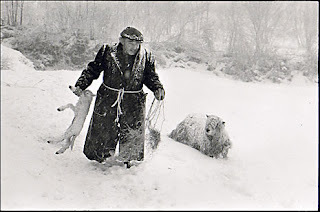
My own images of abandoned communities lack the sort of people that populate James's images and my images have less of an impact because of this absence of characters. It is for this reason that I pour over his images with a mixture of admiration, inspiration and pleasure but also with some sadness that 'my' characters, 'my' subjects have gone and left only silence.


All images © James Ravilious
When I saw his images I was impressed, very impressed. They seemed to be carefully crafted, perfectly composed and had a surreal quality to them.

James was the son of the famous painter Eric Ravilious and you can sense the influence painting and in particular, British painting had on James's work.
I find the images of rural life in Devon he did for the Beaford College stunning. The quality of the black and white images is superb, with detail in the shadows and highlights, even when he was shooting into the sun. His compositional skill is what I admire the most. James was a great admirer of Cartier-Bresson and many of James's pictures have that 'decisive moment' feel but also touches of surrealism.

James managed to achieve many candid shots because he had a strong relationship with the community he was photographing. He was accepted and his subjects were relaxed in his presence.
His images of rural life in north Devon is much more than just a record of a way of life in steady decline. They are poignant and beautiful. He captured all aspects of rural life in that area and created a tapestry of scenes of a way life which was disappearing. There was no real narrative I suppose, with a beginning and an end, it just was what it was, before it changed forever.

My own images of abandoned communities lack the sort of people that populate James's images and my images have less of an impact because of this absence of characters. It is for this reason that I pour over his images with a mixture of admiration, inspiration and pleasure but also with some sadness that 'my' characters, 'my' subjects have gone and left only silence.


All images © James Ravilious
Subscribe to:
Posts (Atom)