Showing posts with label history. Show all posts

Sunday, 8 January 2017

Hill of Fare and the Battle of Corrichie


Recently my wife and I went for a walk on the Hill of Fare. Despite having lived in Banchory for 4 years, and nearby for over 20 years, I'd never been on the Hill of Fare. 

At one point in the walk we came upon this ruined cottage:


I've been told it's known as the Shepherd's Cottage. 
An old Leopard Magazine (October 2008), had an article written by David Coleman, and in it, David suggests it was an under-keeper's home and that it was built between 1896 and 1910.

The cottage is close to the site of a battle that took place in October 1562, fought between Mary Queen of Scot's half-brother, Lord James Stewart's men and Sir John Gordon, the Earl of Huntly's men.

The build up to this battle is a long story but essentially, Catholic Mary was now Queen of a mainly Protestant Scotland and, although she continued to privately attend Catholic mass, she publicly reassured Protestant nobles and Scots that she was Queen of a Protestant Scotland. Also, Mary knew that she would never succeed to the English crown if she showed any inclinations and support for the Catholic faith.

The Earl of Huntly kept encouraging the Queen to declare her support for the Catholic church. Huntly was also jealous of the power and positions awarded to James Stewart. Mary eventually decided to take action against Sir John Gordon and so strengthen her claim to the English throne.

At the battle, not far from where this ruined cottage now sits, James Stewart's forces were completely victorious. Sir John Gordon, the Earl of Huntly dropped dead on the battlefield, and his two sons John and Adam were taken to Aberdeen. John, and other leaders were beheaded in the Castlegate. It is said that James Stewart forced Mary to watch the executions of these Catholic supporters.

What happened to the deceased Earl of Huntly is worth telling. In order for him to be put on trial for treason and his lands confiscated, his body was preserved and sent to Edinburgh where he was put on trial, in his coffin, in 1563. The lid was removed so he could 'hear' the charges against him!

The Earl of Huntly, 'The Cock o' the North', was eventually buried in Elgin Cathedral, three years later.

Wednesday, 4 January 2017

Meikle Kinord.


Hello again.

I took a wander round Loch Kinord yesterday and passed this building. I find it a very photogenic building. I always think it looks like a school house, but it is a private chapel built, perhaps, on the site of a 16th Century chapel. From the Canmore website:

" A chapel was built near Meikle Kinord (NO 44 98) in the 16th century to serve the castle in Loch Kinord (NO49NW 16). There is now no trace, but the sites of chapel and graves were pointed out before 1858, and the walls and gravemounds were remembered by older inhabitants in 1910. A Medieval font of rough granite, 5 feet 2 1/2 inches in circumference, was found near the site of the chapel.
J G Michie 1910; J Stuart 1868.
No trace of chapel or graveyard, but it is believed locally that the private chapel at NO 4407 9891 occupies the site of an older chapel. This later structure built c 1880, was converted into a museum in 1912 to house the oak canoes etc found in the area, but is now used only as a hay-store.
Visited by OS (N K B) 12 November 1968."

By chance I was reading Glen Tanar: Valley of Echoes and Hidden Treasures by François Louis Pierre Fouin, and came upon this:

Mr and Mrs Charles Wilson, who built Dinnet House in 1890, also built the old chapel at Meikle Kinord in the same year. Although never consecrated, the building was used to store local artefacts and in particular, one of the old Pictish canoes from Loch Kinord. When Mr Wilson sold the Kinord Estate to James C Barclay Harvey in 1896, Mrs Wilson was so irate that she hurled all the historic relics out on the moor. The Wilsons took the canoe back to Lincolnshire when they flitted, but because it was too long and bulky to go on to a railway wagon it was allegedly sawn in half. (p.114)

Monday, 10 March 2014

Portrait of a cow, Friggie-Fraggan

'...in large part, migration from the land before the 1940s has to be explained in terms of the changing attitudes of the farm labour force itself. Here it should first be recognised that Scottish farm servants had a developed culture of mobility long before the rural exodus accelerated.[...]'Flitting' (or moving) to another farm, usually in the same parish or county at the end of the six-month or annual term was part of the way of life.[...]Almost all this habitual movement was localised and over short distances but it accustomed farm servant families to levels of mobility that could in certain circumstances encourage them to leave the land altogether.'

From 'The Scottish Nation, 1700-2007' by Tom Devine, pages 464-465.

In the North East of Scotland, you have to realise that many families left voluntarily. This can alter how I feel within an abandoned place but it may also alter the relationship a viewer may have to my images - if they know their history. Should I add history to my images or made up stories?

My thought for tonight after a day at work that not only sapped my energy but also my spirit. Tomorrow is another day. Maybe time for a job flitting?

Monday, 18 November 2013

Looking out for the past in the present, Allalogie.

Had a great weekend this weekend.

It kind of started on Thursday night in Tarland at a talk and mini concert by a local accordian player called Rob McCombie. Great stories of his life and dance bands of north east Scotland followed as well as tunes to enhance the talk.
One of the best bits for me was finding out he was brought up in the house we own. So if you wanted to hear one of the best accordian players in the Howe of Cromar back then, you came to our house we now live in! What is interesting is, if you wanted to hear one of the best accordian players in the Buckie area, you came to our old family home to hear my late father play. He played in a dance band called Bill Geddes Band all along the coast and in land too.

On Sunday I met up with Janet, a lady I know from our local history group. She wanted to show me an abandoned house I hadn't been to before. It was a great wee place with some interesting rooms. In fact, I enjoyed the area the ruin was in so much, I went back alone in the afternoon to explore further. This is when I took this shot of me standing looking out the bedroom window.

The textures of the hole in the roof and the hole in the floor I thought were wonderful. I also liked the shadow cast by the jam jar. This was a 3s exposure so I placed myself at the window for one of the many 'ghost' shots I seem to be doing at the moment. It seems to fit the mood of these abandoned, forgotten and derelict places. Maybe it's cliched and unimaginative but I like doing them for now.

Later, I went for a walk in the area and who should I meet but the accordian player Rob! That was a nice surpise meeting and chat. He is keen to come to see his old home. We are looking forward to it and I'm hoping he will once again fill the house with music. What sounds were common in Allalogie I wonder?

Threads of history and traces of memories are there to be found. Remembering and celebrating past places, events and people I truly enjoy and will keep on exploring and capturing abandoned Aberdeenshire.

Wednesday, 10 July 2013

Why do I like Diane Arbus and what can I learn from her work?


I have written about my admiration for the work of Diane Arbus before in this blog - Aberdeen Art Gallery;  Barcelona;  the impact she had on me to get back into photography.

Strangely enough, I have never asked myself why I like her work. What is it about her images that I find so intriguing and interesting? After all, the photographs I take are nothing like her work.

I am finding it hard to put into words why I like her images.

I too take images of communities who lived on the edge - on the margins of civilisation, remote, far from amenities and facilities. Outsiders perhaps?

Yes, my images also contain ugliness and a lack of beauty but then we all know what they say about beauty.

I can't say I challenge the viewer as perhaps Arbus's work does, however I am trying to alter the experience of the viewer to decay, debris and to stuff that was once loved and admired but left behind. Some see Arbus's images as portraying people full of despair but I find them intriguing and remarkable. Her "deviant and marginal' people seem to be doing the best they could under some difficult circumstance, within a society that rejected their lifestyle and for some, rejected their shape, size and sexual orientation. Her images are, to me, full of energy and life, as well as compelling. Her work is raw, at times disturbing, unflinching but what an insight we get to a world we would never have seen otherwise.

There is no doubt you can feel like an intruder, a voyeur when looking at her work. Her subjects and the lives they led are almost 'run of the mill' these days, with TV programmes filling late night spots with 'embarrassing bodies' and the like. Looking at my images of someone else's home, albeit abandoned and in a state of decay, may feel like intruding and you may want to look away or you may get a feeling of foreboding - "what will happen to my home, to my 'stuff', when I'm gone?"

Many of Diane Arbus's images hold my attention but also make me want to look away and perhaps it is that conflict that, for me, makes her work so captivating.

So what can I learn from her work? Eric Kim asked the same question regarding his street photography. I have changed his blog post to consider rural exploration/abandoned communities instead of street photography:-

1. Go places you have never been

Arbus shares some of her thoughts:
“My favourite thing is to go where I’ve never been. For me there’s something about just going into someone else’s house. When it comes time to go, if I have to take a bus to somewhere or if I have to grade a cab uptown, it’s like I’ve got a blind date. It’s always seemed something like that to me. And sometimes I have a sinking feeling of, Oh God it’s time and I really don’t want to go. And then, once I’m on my way, something terrific takes over about the sort of queasiness of it and how there’s absolutely no method for control."

I constantly read local history books and scour maps to find new places, never knowing what I'll find. The planning and the journey to find the abandoned place plays a huge part in my work.

2. The camera is a license to enter the lives of others

As Arbus explains:
“If I were just curious, it would be very hard to say to someone, “I want to come to your house and have you talk to me and tell me the story of your life.” I mean people are going to say, “You’re crazy.” Plus they’re going to keep mighty guarded. But the camera is a kind of license. A lot of people, they want to be paid that much attention and that’s a reasonable kind of attention to be paid."

Documenting abandoned and disappearing communities deserves attention and my camera, my project, has got me into properties to capture the fading memories of lives long since past.

3. Realise you can never truly understand the world from your subjects eyes

"You might have a certain intent when photographing, but the result can be totally different. Not only that, but what we may perceive as a “tragedy” may not be considered as a tragedy to your subject:
And that has to do with what I’ve always called the gap between intention and effect. I mean if you scrutinize reality closely enough, if in some way you really, really get to it, it becomes fantastic. You know it really is totally fantastic that we look like this and you sometimes see that very clearly in a photograph. Something is ironic in the world and it has to do with the fact that what you intend never comes out like you intended it.
What I’m trying to describe is that it’s impossible to get out of your skin into somebody else’s. And that’s what all this is a little bit about. That somebody else’s tragedy is not the same as your own“.

I feel many emotions in empty cottages, but they are really what I imagine it must have been like either to live there or how it felt to have to leave. They are only my emotions.

4. Create specific photographs

“A photograph has to be specific. I remember a long time ago when I first began to photograph I thought, There are an awful lot of people in the world and it’s going to be terribly hard to photograph all of them, so if I photograph some kind of generalized human being, everybody’ll recognize it. It’ll be like what they used to call the common man or something.
It was my teacher Lisette Model, who finally made it clear to me that the more specific you are, the more general it’ll be. You really have to face that thing. And there are certain evasions, certain nicenesses that I think you have to get out of."

More and more I am taking shots that, may not have the compositional appeal or be pleasing to the eye, but mean something to me. I may have been moved by something left behind or some part of the cottage may have brought back a personal memory - either way, the image I take on those occasions resonate with people much more than the bog standard abandoned cottage shot.

5. Adore your subjects

“Freaks was a thing I photographed a lot. It was one of the first things I photographed and it had a terrific kind of excitement for me. I just used to adore them. I still adore some of them, I don’t quite mean they’re my best friends but they made me feel a mixture of shame and awe."

I think it is clear that I love local history!

6. Gain inspiration from reading

“Another thing I’ve worked from is reading it happens very obliquely. I don’t mean I read something and rush out and make a picture of it. And I hate that business of illustrating poems.
But here’s an example of something I’ve never photographed that’s like a photograph to me. There’s a Kafka story called “Investigations of a Dog” which I read a long, long time ago and I’ve read it since a number of times. It’s a terrific story written by the dog and the real dog life of a dog."

I think it is clear that to be a better photographer, it is important to embrace life, to get inspiration for many aspects of life be it reading, music, travel, walking, etc.

7. Take bad photos

“Some pictures are tentative forays without your even knowing it. They become methods. It’s important to take bad pictures. It’s the bad ones that have to do with what you’ve never done before. They can make you recognize something you had seen in a way that will make you recognize it when you see it again."

I am realising this more and more. The more I fail, the more I learn. But I can't fail if I don't get out and shoot. Of course it is crucial to understand what went wrong and how might that be fixed. Accidents are a different thing altogether. 

8. Sometimes your best photos aren’t immediately apparent (to you)

“Recently I did a picture—I’ve had this experience before—and I made rough prints of a number of them, there was something wrong in all of them. I felt I’d sort of missed it and I figured I'd go back. But there was one that was just totally peculiar. It was a terrible dodo of a picture. It looks to me a little as if the lady’s husband took it. Its terribly head-on and sort of ugly and there’s something terrific about it. I’ve gotten to like it better and better and now I’m secretly sort of nutty about it.”

Oh, how I would love to have a picture editor! So important to go back over old work with a new mind.

9. Don’t arrange others, arrange yourself

“I work from awkwardness. By that I mean I don’t like to arrange things if I stand in front of something, instead of arranging it, I arrange myself”.

Very rarely do I move stuff around to make a better picture. I'm not sure why I have this approach. It could be that I want to show respect to the previous owners or that I feel it is important to show the property as I find it. The jury is still out on this one.

10. Get over the fear of photographing by getting to know your subjects

To overcome her fear of shooting junkies people in a park (who frightened her) – Diane would revisit over and over again, and found out over time she became less timid. Not only that but she got to know the people there, and asked for permission. This helped her feel more comfortable and photograph the people in the area.

I have overcome my feeling of intruding, my fear of been 'found out' and continue to work on my confident manner when approaching locals or when confronted by concerned individuals who want to know what I'm doing. Often the conversation ends in my favour when they tell me about other abandoned cottages.

11. Your subjects are more important than the pictures

Although Arbus was criticised much during her lifetime (and even now today) for seemingly lacking compassion – she certainly did care for her subjects more than the photos themselves:
“For me the subject of the picture is always more important than the picture. And more complicated. I do have a feeling for the print but I don’t have a holy feeling for it. I really think what it is, is what its about. I mean it has to be of something. And what its of is always more remarkable than what it is.”

I have to give this one more thought because I think I amy be going in the opposite direction. Initially, it was all about the history of these abandoned glens and documenting them before they fell into even more ruin. Other photographers suggested I focus my work more on the details of the cottages, more on producing images that evoke emotions and memories. I'm trying to do this and enjoying the challenge but, to be fair to myself, I sense it will make me want to delve even deeper into the my interest, my passion, to hopefully produce better images.


Diane Arbus was not only a ground breaking and controversial photographer, but she also had deep feelings and emotions with and for her subjects. This clearly comes across in her photography. She followed her heart in her photography and took photos of subjects that not only interested her but felt compassion and warmth towards.

( All Arbus quotes from Diane Arbus: An Aperture Monograph.

Thursday, 30 June 2011

The female POV

My experience of female photographers on the internet on sites like Flickr, is that they can be the most inspiring, creative and exciting exponents of the craft of photography seen today, but they can also be the most predictable, boring and self indulgent of all photographers. Self portrait after self portrait, flower after flower, shoes after shoes, pet after pet, baby after baby.  That said, it was seeing the work of a female photographer (Diane Arbus) that slapped me across the face and woke me up to the power of photography again.

To get to the point of this post - can (and should) forms of expression be discussed in 'men's' or 'women's' art? Does gender affect output? (Not many female landscape photographers is there?) Does gender of the photographer affect the viewer's response to the image?

Well, having listened to Jeff Curto's Class # 11, Spring 2011 podcast, the answer seems to be, no. Time and place determine style, not gender. The so called golden era of photography (1880-1920s) coincided of course with social, cultural and political change, especially for women. Historically, photography has been a male dominated field, due partly to the technical and scientific nature of the art form, but also due to the fact that men were involved in photography as a commercial, money making venture. Women's place remained in the home, as wife and mother, until quite recent times. Women were often stuck at home and not until there was a series of technological advances which could 'release' them from the home, could they grab the new Kodak and shoot the flowers, pets, babies and friends that surrounded their world, i.e not too far from the hearth. Working class women of course remained in a life of poverty and toil, in the factory or working in the 'big house'. Interestingly, many started late in life to help deal with 'empty nest syndrome'. Women moved from the hearth to groups like the photo secessionists, FSA and f64. They were soon making social and political comment and embracing all technical aspects of their craft.

As their world changed and more opportunities opened up for women photographers, they have produced some of the most creative, original and powerful pieces of work. They have moved far from the hearth and are often at the forefront of photography. A great excuse to show some examples of the development of women photographers (mostly American):

Julia Margaret Cameron:

Lady Clementina Hawarden:

Frances Benjamin Johnston

Gertrude Kasebier

Anne Brigman

Chansonetta Stanley Emmons

Imogen Cunningham

Dorothea Lange
Marion Post-Wolcott
Margaret Bourke-White

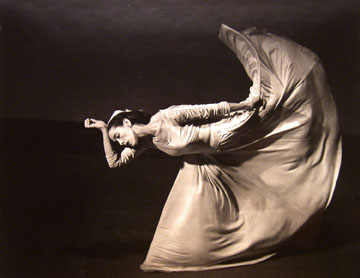
Barbara Morgan

Diane Arbus

Marie Cosindas

Olivia Parker

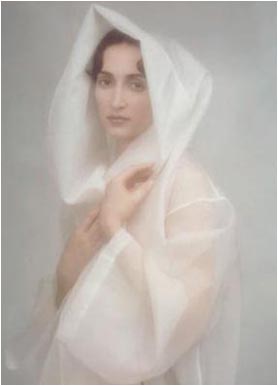
Joyce Tenneson

Sally Mann

Annie Leibovitz

Connie Imboden

Cindy Sherman
Mary Ellen Mark

Susan kae Grant


Thanks again to Jeff Curto's History of Photography.

Sunday, 29 May 2011

Alfred Stieglitz and the Photo Secessionists

There can't be many photographers who haven't heard of Alfred Stieglitz nor be unfamiliar with his classic Steerage:


What I wanted to learn more about was the curiously named group of photographers called the Photo Secessionists. I listened to Jeff Curto's History of Photography Class 9 Spring 2011 to find out more.

In its early life, photography wasn't sure what it was to do with itself. Was it art or commerce? It tried to be art by mimicking styles, look, subject and composition of painters.
Pictorialism was the name given to an attempt to make photography an art and be taken seriously. The subject matter came second to the finished product. Manipulation was common to try to achieve the look of a painting and to produce something that didn't actually exist. Fictional stories were reproduced in images and multiple negatives were used to create fantasies, or recreations from mythology or the Bible.

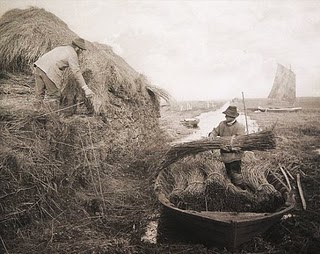
Peter Henry Emerson, an iconoclastic photographer in a way, wanted honest depictions of real people and spoke out against 'art' photography. He even used processes and slightly out of focus techniques to simulate what he considered a more realistic view a normal person's vision. His beautiful images from the Norfolk Broads in England:

 Emerson eventually convinced himself in the 1890s that photography was not art but just a copying device.

If I have understood the thinking behind the Photo Secessionists correctly, Alfred Stieglitz wanted to combine the realism Emerson spoke about but produce pictures that were not only realistic, of the moment and often technically superb, but had a deeper meaning and were also beautiful prints. What was in front of the camera was less important. What was important was to break away from the narrow rules and customs of the day.
He was also one of the first to just print part of the negative and he often used small cameras, relatively speaking of course. He also managed to produce stunning night time shots when taking the basic technology at his disposal into consideration:
Some more examples of his work:


Not only was Stieglitz an influential photographer, he was also a promoter of American photographers. He set up a yearly salon and the group, Photo Secessionists. The idea behind the secessionists was to break away from photography of the past and make photography its own thing, to change thinking about what constituted a photograph. He wanted to advance photography to a higher artistic form and make an active protest against the old thoughts on photography and, perhaps more controversially, the dictatorship of the entrenched institutions, galleries, art schools and professional art organizations that enforced or at very least sanctioned copying or imitation. (http://en.wikipedia.org/wiki/Photo-Secession)

 Some examples of work by Photo secessionists:
Gertrude Kasebier:
Edward Steichen:
Clarence White:

Alvin L Coburn:


Anne Brigman;

Robert Demachay:

So there you have it, a short introduction to the Photo Secession movement which I hope may stimulate you to find out more.

Thanks again to Jeff Curto's History of Photography.

Sunday, 8 May 2011

The choices landscape photographers make - but make the same shot.

If you ever get to the Isle of Skye (is it still called that now it has a bridge to the mainland?) and you drive from Portree to the Old Man of Storr, you will come upon this view and will more than likely take a shot, as I did:

Now, if you Google Image 'The Old Man of Storr', the results will throw up very similar images, including the above view, for example:
So, am I guilty of plagiarism? No, of course not because there are 'honey-spots' like this all around the world. Do a Google Image search for Eiffel Tower, Houses of Parliament, Empire State Building, Great Wall of China' Tower of Pisa, etc. and you'll get my drift.
My shot of the Old Man of Storr (the black and white one) I titled 'So you think I should have just kept on driving?' because I was very aware of how cliched the shot was when I uploaded it to my flickr account. I felt the same about this shot I took standing at the Old Man of Storr:
There are many, many more better pictures of this scene on the internet, but I still took it and posted it. Take a look at Billy Currie's one for example:

Billy's shot is far superior to mine so why did I bother posting my effort? Well, I feel by taking the shot and making a decent effort, and then comparing it to others I can learn and improve by considering what my shot didn't have that a better picture did. (Let's not forget the basic function of letting friends and family see some of my holiday snaps!)
Now, here's the thing, I hadn't seen his shot before taking mine. In fact, I can honestly say that I never consciously studied any picture of the scene before going there to take it. I ended up at that spot because the well worn path led me there!

Nineteenth century photographers shot the same scene over and over again for financial reasons (people would buy prints of popular places and landmarks) and it was expected of you if you wanted to be known as a travel/landscape photographer. There was a high demand for these popular scenes and photography was a business so they satisfied a demand and flooded the market with views of foreign lands and stunning natural and man-made monuments.
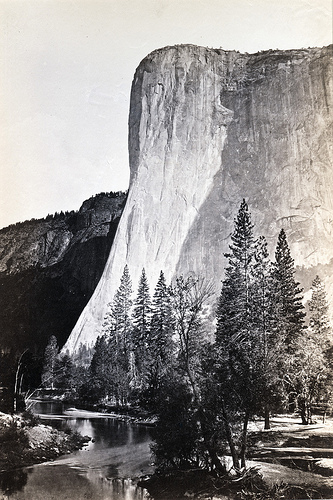
I then wondered how competitive this market was. These early Victorian photographers were exploring and venturing into wilderness and if you found a stunning view, positioned yourself to capture it effectively you could make a bit of money with such a print. Consider then how annoying it must have been to have someone follow in your footsteps and find the exact same point.  El Capitan in Yosemite by Carleton Watkins:
And by Eadweard Muybridge:

You don't have to be any kind of expert to see why some photographs of exactly the same spot can be more pleasing to the eye than others. In today's competitive, saturated market how can a landscape photograph stand out? Removing the subject matter in a landscape photograph (because in this scenario it is the same), what choices do photographers make to help them create a 'different' shot of the same scene?

  1. Time of day, time of year and quality of light. Weather conditions also.
  2. Your point of view. Are you going to stand exactly where everybody else stands?
  3. Your field of view. What will you include/exclude?
  4. Horizontal or Vertical?
  5. Lens choice - will either pull the subject closer or push it farther away (unless using a standard lens).
  6. Camera choice, medium choice, camera settings.
  7. People/objects included or not.
Here's a question for you - if you were to include something personal to a classic view, let's say for example a red chair in the classic Glencoe shot and then somebody went back to the exact same spot with a yellow chair, took a shot, is that plagiarism? Or is it flattery? 

On a similar theme take a look at the work of Klett & Wolff


Thanks again to Jeff Curto's History of Photography. This blog was inspired by his Spring 2011 Class 7. 

Friday, 29 April 2011

Photography and painting: a symbiotic relationship.


Imagine being a portrait painter in the 1840s and watching with some concern, the growth in the popularity of this bastard child of art and science called 'photography'.
Photography, created in 1839, was tied closely to the conventions of art at the time and early photographs mimicked, not only the subject matter of paintings, e.g. still lifes, portraits and landscapes, but some even tried to look like a painting by manipulating the plate to give the impression of brush strokes. So photographers initially tried to give this new medium some status by trying to produce photographic paintings. But with the sensitivity of early plates, especially to blue, skies were often washed out. Landscape painters could show up this limitation by 'completing the picture' you, might say. For example: Gustave Courbet's 1874 painting of Chateau de Chillon
can fill in the washed out sky and mountains of Adolphe Braun's photograph of c.1863-65:

Portrait painters painted the emotion of the sitter but photography showed the real emotion, the real person and this shocked but fascinated people. Take Julia Margaret Cameron's portrait of J.F.W. Herschel of 1867 and I think you'll see what I mean:
The power of these photographs must have alarmed portrait painters. Edward Steichen's striking portrait of JP Morgan made artists go in the opposite direction, e.g. Matisse's 'green stripe lady'.

On top of this, the detail in photographs could be looked at very closely whereas, the closer you got to a painting, the more you saw the paint strokes. Painters painted the light coming from the object and close up, it just looked fuzzy.
Early photographs were in monochrome so shapes were easier to define and use, creating more artistic images such as Timothy O'sullivan's survey work:

Photographers also had to frame their image but of course artists didn't have to, allowing some 'artistic license in the accuracy of their work. In fact, when photography took over the role of 'recording the world' from painters, it allowed painters to stop representing the world and experiment. Photography could also explore the emotions that painters used and produce what is often termed 'pictorialism'. Alvin Langdon Coburn's photograph of a bridge in Venice, for example:
Some painters, quite early on, used photography to record the human body in various poses to help in the construction of paintings. Thomas Eakins is a good example of this:

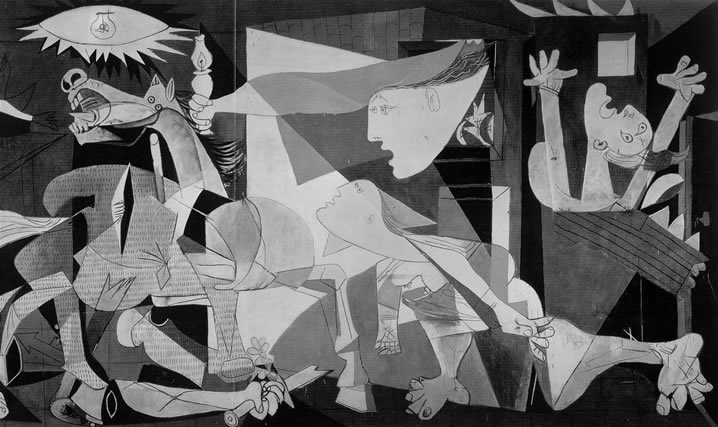
At the early stages of photography, there were two things photographers couldn't do - complete abstract images and very large images. This was an area where painters could deflect attention away from photography back onto themselves. Picasso was, not only painting figures and portraits in a way that no photograph could do, but was depicting the horrors of war, as well as, if not better than any photographer.
Jackson Pollock removed any subject matter from the paiting and his image was all about the material, i.e the canvas and the paint (not to mention the evidence of his presence on the canvas). How do you compete with that photographers? Well, Lucas Samaras put his 'mark' on his polaroids as they were developing.

Did Duchamp get inspiration from Muybridge for his 'Nude descending a staircase'?

Dorothea Lang and Robert Frank may well have been inspired by social realist painters. Maybe not James Guthrie of the Glasgow Boys, but I think you can see what I'm suggesting.
Some photographers use photoshop, make up and props to get their photographs to look like old paintings, e.g. Cindy Sherman
And, most recently, painters have gone to amazing technical lengths to make their paintings look like a photograph (often a bad photograph to begin with too!). Alyssa Monks is a fine example of this craze.

Thanks again goes to Jeff Curto's History of Photography. This blog was based on his Spring 2011, class 6.